
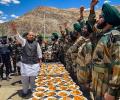
Defence Minister Rajnath Singh on Monday said India is a peace-loving nation that never resorts to any kind of aggression but is always prepared to give a befitting reply if provoked or threatened.

Sector-wise, banking, IT, pharma and realty indices drove the market momentum.

Mallya remains on bail pending his UK High Court appeal, now scheduled for February 2020.

In the last budget, then finance minister Arun Jaitley had allocated Rs 85,010 crore for the education sector which was later revised to Rs 83,625.86 crore.

Sitharaman said the government will bring in a new national education policy to transform India's higher education system into one of the best in the world.

Even if the Paytm fiasco does not mark the end of the bull run, at least some sanity will return to the wild IPO market, observes Debashis Basu.

Ola has reported its first operating profit of Rs 89.82 crore for 2020-21, even as the ride-hailing company's revenue declined 65 per cent to Rs 689.61 crore amid COVID-19 induced lockdowns. As per regulatory documents filed by ANI Technologies - the parent company of Ola - it had logged standalone operating profit (profit before finance cost, depreciation, amortisation and tax (EBITDA)) of Rs 89.82 crore in FY21 on a standalone basis, while it had registered a loss of Rs 610.18 crore in the preceding fiscal year.

RBI's foreign exchange reserves fell $237.5 million.

Top gainers in the Sensex pack were TCS, Bharti Airtel, Infosys, Axis Bank, L&T, ITC, PowerGrid, HCL Tech and Tata Steel, ending up to 2.39 per cent.

Recently listed companies scored 54, compared to 58 for the BSE100 firms and 61 for entities in the Sensex pack. The report noted that issues remain in IPO companies in which there seems to be a need to institutionalise governance practices.

Investors booked profits in range-bound trade, led by PSU, oil & gas, energy, infrastructure, telecom, realty, healthcare, bankex, FMCG, capital goods and power counters.
Total income rose to Rs 19,322.63 crore during the quarter under review, was up 17.08 as against Rs 16,502.97 crore.

The markets are showing no signs of stability as the economic impact of the coronavirus outbreak is likely to be significant for many major economies.

The combined dividend payout by early-bird companies -- those that have declared their results for FY21 -- is up 8.9 per cent, lower than the 21.9 per cent rise in in FY20 but ahead of the underlying growth in India Inc business last year. Combined net sales of these early birds were down 1.8 per cent last financial year while net profit was up 27.3 per cent in FY21. Some top companies that have stepped up dividend payout in FY21 include Hindustan Unilever, Indus Towers, Tata Steel, Ultratech Cement, Larsen & Toubro, Dabur, Asian Paints, and UPL. In contrast, banks have skipped dividends under an RBI diktat while companies such as Marico, TCS, Maruti Suzuki, and Godrej Consumer are paying lower dividends for FY21.

The rupee recovered from more-than three months low of 63.15 in early trade on dollar selling by banks.

After unseasonal rains, supply disruptions and pandemic-induced woes pushed retail inflation well over the Reserve Bank's comfort zone in 2020, the scenario is likely to stay that way at least in the short term as economic recovery slowly gains foothold. For most part of this year, pricier food items pushed the retail inflation, based on Consumer Price Index (CPI), higher in the range of 6.58-7.61 per cent, except for March when the reading was 5.91 per cent. Experts believe retail inflation is likely to average around 6.3 per cent this fiscal and mostly will remain sticky going forward owing to pick-up in demand across sectors.

Rupee is under pressure against the dollar say currency watchers.

Positive cues from the global market front aided the rally.

In the past 12 months, since September 2020, the net cumulative increase in employment has been just 44,483. This is negligible -- just 0.04 million on a base of over 400 million jobs, reveals Mahesh Vyas.

IIP growth rises to 9-month high of 4.3 pc in August

Multiple reasons accounted for the losses, including manpower crunch and lack of clarity on the merger of National, United and Oriental, reports Namrata Acharya.

Mahindra and Mahindra was the top gainer in the Sensex pack, surging over 16 per cent, followed by Maruti, Titan, Bajaj Finance, HDFC, Bajaj Auto and Hero MotoCorp. On the other hand, HUL, Tech Mahindra, IndusInd Bank and Nestle were the laggards.
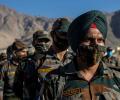
The political-electoral calculus favours spending thousands of crores on vanity projects like Sardar Patel's statue and the Central Vista over building up our military to handle the confrontations and conflicts that loom large, points out Ajai Shukla.
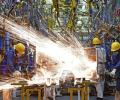
Capital goods, a barometer of investments, showed a sharp increase in output by 14.6 per cent in January, 2018 as against a decline of 0.6 per cent year ago.

Growth in credit card outstanding has been the fastest compared to other personal loan segments

The internals of the food inflation are worrying, given a broad-based uptick across categories that tend to be sticky, such as proteins, and a narrower-than-expected reduction in inflation for vegetables.

SBI was the top gainer in the Sensex pack, rallying over 10 per cent, followed by Kotak Bank, Dr Reddy's, UltraTech Cement, ITC and HDFC Bank. On the other hand, Axis Bank, Bharti Airtel, ICICI Bank, Maruti and HCL Tech were among the laggards.
After a sharp sell-off in the past two months, overseas investors were once again seen turning bullish on Indian equities. FIIs bought shares worth Rs 63.5 billion in the past five sessions, their highest weekly investment tally in many months.

Insiders enable 61% of frauds financial services hit the worst.

Its economy dependent on tourist arrivals, the hill state is looking at a summer of discontent. Not that the rest of the year promises to be any different. Ashwani Sharma reports from Shimla.

As a model of transport, the A380 strikes a parallel -- a shared fragility -- with giant container ships, observes Shyam G Menon.
The plan includes step-wise expansion of a crucial credit guarantee net, establishment of an unprecedented number of functional clusters and increased government procurement from MSMEs.

Divestment in BPCL, SCI, Concor, NEEPCO, and THDC would help the Centre keep its fiscal deficit in check in the wake of subdued tax revenues and a Rs 1.45-trillion hit for the exchequer from corporation rate cuts.

The power infrastructure and the farm sector have also suffered a considerable damage, Chief Secretary A K Tripathy said. However officials said the telecom infrastructure is largely intact.

Overall business confidence index is at 6-quarter high: Ficci survey

For the week, the Sensex recorded a fall of 371 points, or 1.10 per cent, and the NSE Nifty 130.75 points, or 1.25 per cent.

'The USA crossed 50,000 deaths in 23 days, Brazil in 95 days and Mexico in 141 days. India took 156 days to reach this national figure'

Insurance penetration in India at 3.9%, below world average.

The number of recoveries from COVID-19 exceed active cases by more than 10 lakh.
